

Match the compressor to the power your building already has. Single phase is the usual supply in homes and small garages. Three phase is the usual supply in commercial and industrial buildings and runs larger motors more smoothly. Ask an electrician which one your service is before you order. A 3 phase compressor will not run on a single phase supply as it is, and a single phase unit draws more current than a 3 phase unit of the same horsepower.
Key takeaways
- Check your electrical service first. It decides which electric compressors you can run.
- Homes and small garages usually have single phase. Commercial and industrial buildings usually have three phase.
- On Mi-T-M's 5.0 HP, 230V, 80 gallon models, the single phase unit lists 23.0 amps and the 3 phase unit lists 13.8 amps.
- If you only have single phase and need more air than a 120V unit gives, ask us about single phase models and gas options.
- Have an electrician confirm voltage, phase and breaker size before you buy.
What is the difference between single phase and three phase power?
Single phase is a two wire circuit: one phase wire and one neutral wire. Three phase uses three phase wires, with the power waves spaced evenly apart. Fluke's power quality guide notes that homes are usually served by single phase, while commercial and industrial buildings usually use three phase, which handles higher loads better. It also says single phase voltage has peaks and dips, while three phase delivers power more steadily.
For a compressor, that matters because the motor does the work. A larger motor on a three phase supply runs smoother and draws less current per leg.
Single phase vs three phase air compressors compared
| Feature | Single phase | Three phase |
|---|---|---|
| Where you usually find it | Homes, small garages, small shops | Commercial and industrial buildings |
| Motor size | Smaller and mid size motors | Mid size to large motors |
| Current draw at the same HP | Higher | Lower |
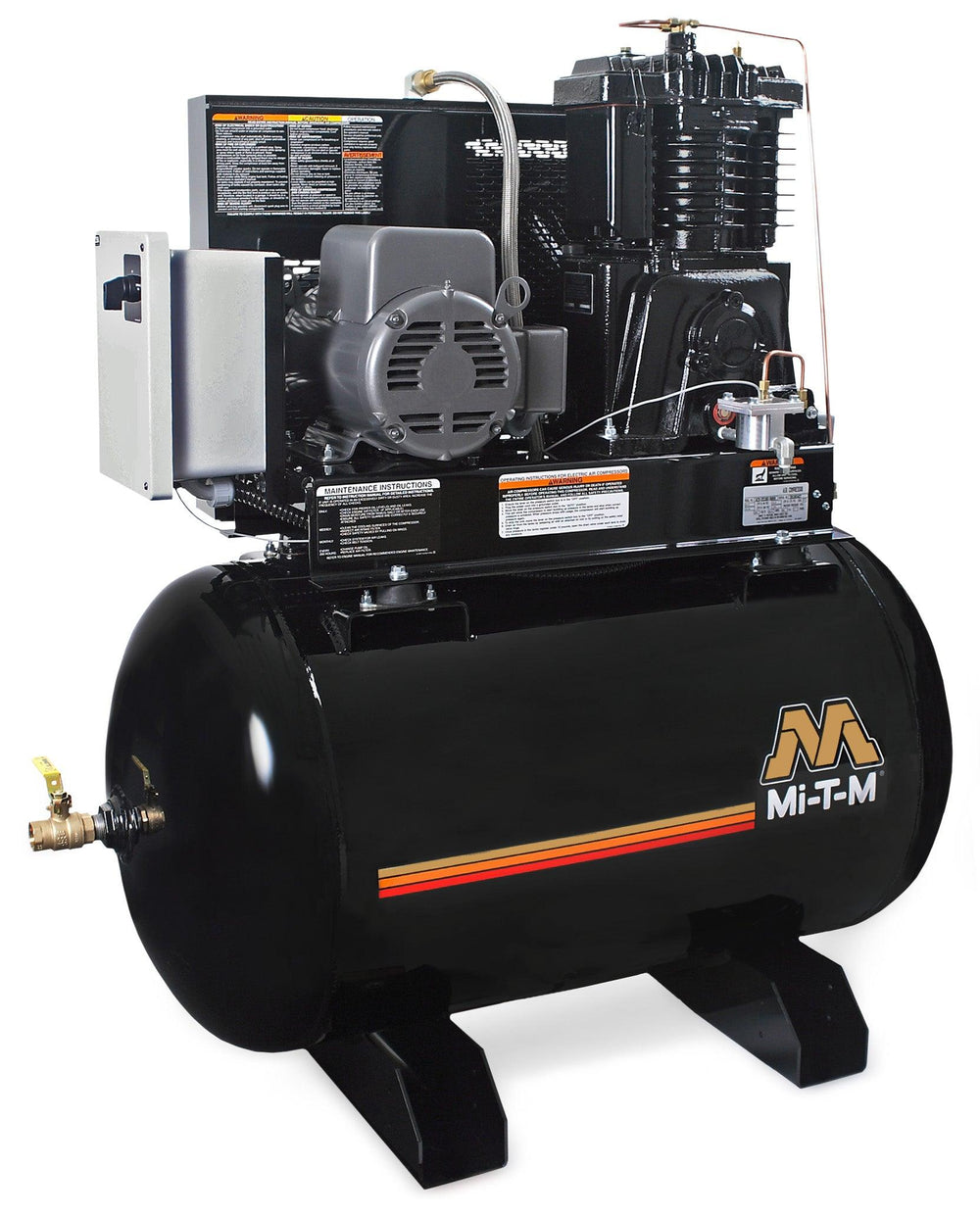
| Example, 5.0 HP, 230V, 80 gallon | Mi-T-M ACS-23105-80H: 23.0 amps, 18.0 CFM at 175 PSI | Mi-T-M ACS-23305-80H: 13.8 amps, 18.0 CFM at 175 PSI |
| Needs a special setup if your service doesn't match | Often a different breaker or wiring | Yes. It will not run on single phase as is. |
The two example units share an 80 gallon tank, 5.0 HP and 18.0 CFM at 175 PSI, according to Mi-T-M's product sheets. The difference is the supply, and the current each one draws from it. Check the nameplate on the exact unit you receive.
Which phase does your shop have?
- Look at the panel. Your breaker panel and your electric bill or utility account often show the service type. Do not open the panel yourself.
- Ask your electrician or utility. They can tell you the voltage and phase at your building and at the spot where the compressor will sit.
- Ask about capacity. A compressor needs a breaker and wire sized for it. Your electrician sizes both from the unit's nameplate.
- Write down what you learn. Voltage and phase are what you need to match to the model.
When single phase makes sense
- Your building has single phase service only, which is common in small shops and garages.
- You want a smaller electric unit. Our 20 gallon Mi-T-M AM1-PE15-20M runs on 120V and is listed at 7.3 CFM at 90 PSI.
- You need more air than a 120V unit gives and have 230V single phase. The Mi-T-M ACS-23105-80H above runs on 230V single phase.
When three phase makes sense
- Your building already has three phase service, which is common in commercial and industrial spaces.
- You want a larger motor drawing less current per leg.
- The compressor will stay in one place. The Mi-T-M ACS-23305-80H is a 230V, 3 phase 80 gallon unit. See all of our 80 gallon air compressors.
What if your power doesn't match the compressor?
A three phase compressor will not run on single phase as it comes. Your options are to pick a model built for the supply you have, ask an electrician about adding a phase converter, or pick a gas model that needs no outlet at all. Each has trade-offs in cost, space and upkeep, so get an electrician's opinion before you buy. For the power source trade-offs, read our gas vs electric two stage air compressor comparison.
Check these before you buy
- Voltage and phase. Both must match the unit's nameplate.
- Amps and breaker. Have your electrician size the breaker and wire from the unit's listed amps.
- CFM at your pressure. Power is only half the choice. Size the pump to your tools. Our guide on what size air compressor an auto shop needs shows how.
- Location. Check the distance from your panel to the compressor spot.
Frequently asked questions
Is single phase or three phase better for an air compressor?
Neither is better in every case. Three phase runs larger motors smoothly with less current per leg. Single phase fits buildings that only have single phase service. Choose the one that matches your power.
Can I run a three phase air compressor on single phase power?
Not as it comes. You need a model made for single phase, a phase converter installed by an electrician, or a gas unit. Ask an electrician before you buy.
How do I know if my shop has single phase or three phase?
Ask your electrician or utility. They can confirm the voltage and phase at your building and at the compressor location. Do not open the panel yourself.
Does a single phase compressor use more amps than a three phase one?
At the same horsepower and voltage, yes. Mi-T-M lists its 5.0 HP, 230V single phase 80 gallon unit at 23.0 amps and its 3 phase unit at 13.8 amps.
Do gas air compressors need three phase power?
No. Gas compressors run on a gasoline engine and need no outlet. They need ventilation and engine upkeep.
Not sure which one fits your power?
Tell us your voltage and phase, how many tools share the air, and where the compressor will sit, and we will point you to a model. Call (833) 767-8247 Monday to Friday, 9 AM to 5 PM CST, or contact our team.