

Size an auto shop air compressor by adding up the CFM your techs use at the same time, then adding about 25 to 30 percent. Kaishan USA's rule of thumb is about 5 CFM per technician. Check that number against your tools' spec labels, make sure the pump delivers it at about 90 PSI, and pick a tank and pump to match. Many shop guides point to a two stage compressor with an 80 gallon tank once two or three bays share the air.
Key takeaways
- Count the techs who use air at the same moment, not the number of bays.
- Plan on about 5 CFM per tech, then add 25 to 30 percent as a margin.
- Most air tools run at 80 to 90 PSI, so look for the pump's CFM at 90 PSI.
- Tank size smooths demand. It does not make up for a pump that is too small.
- Check your electrical service before you order an electric unit.
How do you size an air compressor for an auto shop?
- Count your simultaneous users. Think about how many techs could be on air at the same moment, not how many bays you have.
- Estimate the CFM. Kaishan USA puts a typical auto repair shop at about 5 CFM per tech. For a closer number, add up the CFM printed on the tools you run together.
- Add a margin. Best Buy Auto Equipment suggests adding 25 to 30 percent for leaks and real world conditions.
- Match the pressure. Most air tools need 80 to 90 PSI, per Kaishan. Look for the pump's CFM at 90 PSI, not only its rating at top pressure.
- Choose the tank and pump last. A bigger tank steadies pressure during bursts of use. It cannot fix a pump that does not make enough air.
Here is an example with made up numbers. Four techs on air at once at 5 CFM each is 20 CFM. Add 30 percent and you are shopping for about 26 CFM at 90 PSI. Use your own head count and your own tools.
Which air compressor size fits which kind of shop?
| Shop type | What to look for | Example in our catalog |
|---|---|---|
| One tech, light and occasional use | A small electric unit that covers about 5 CFM with some margin | Mi-T-M AM1-PE15-08M: 8 gallon, 120V, 7.3 CFM at 90 PSI |
| Two to three bays | Higher CFM at 90 PSI, usually a two stage pump and an 80 gallon tank | Mi-T-M ACS-23105-80H: 80 gallon, 10.5 HP, 3 phase, 23.0 CFM at 175 PSI |
| Body shop with paint | At least 15 to 20 CFM at about 100 to 150 PSI, per Quincy Compressor. They say a rotary screw suits steady, high demand, and a piston unit can work for small, low volume shops. | Call us and we will match it to your paint setup |
| Four or more techs on air | Add up the CFM. You may need a larger unit or more than one compressor. | Call us for sizing |
The ACS-23105-80H is listed at 23.0 CFM at 175 PSI. That is the pump's rating at its top pressure, so ask us for its CFM at 90 PSI before you compare it to your number. You can see it and the rest of our auto and body shop air compressors in one place.
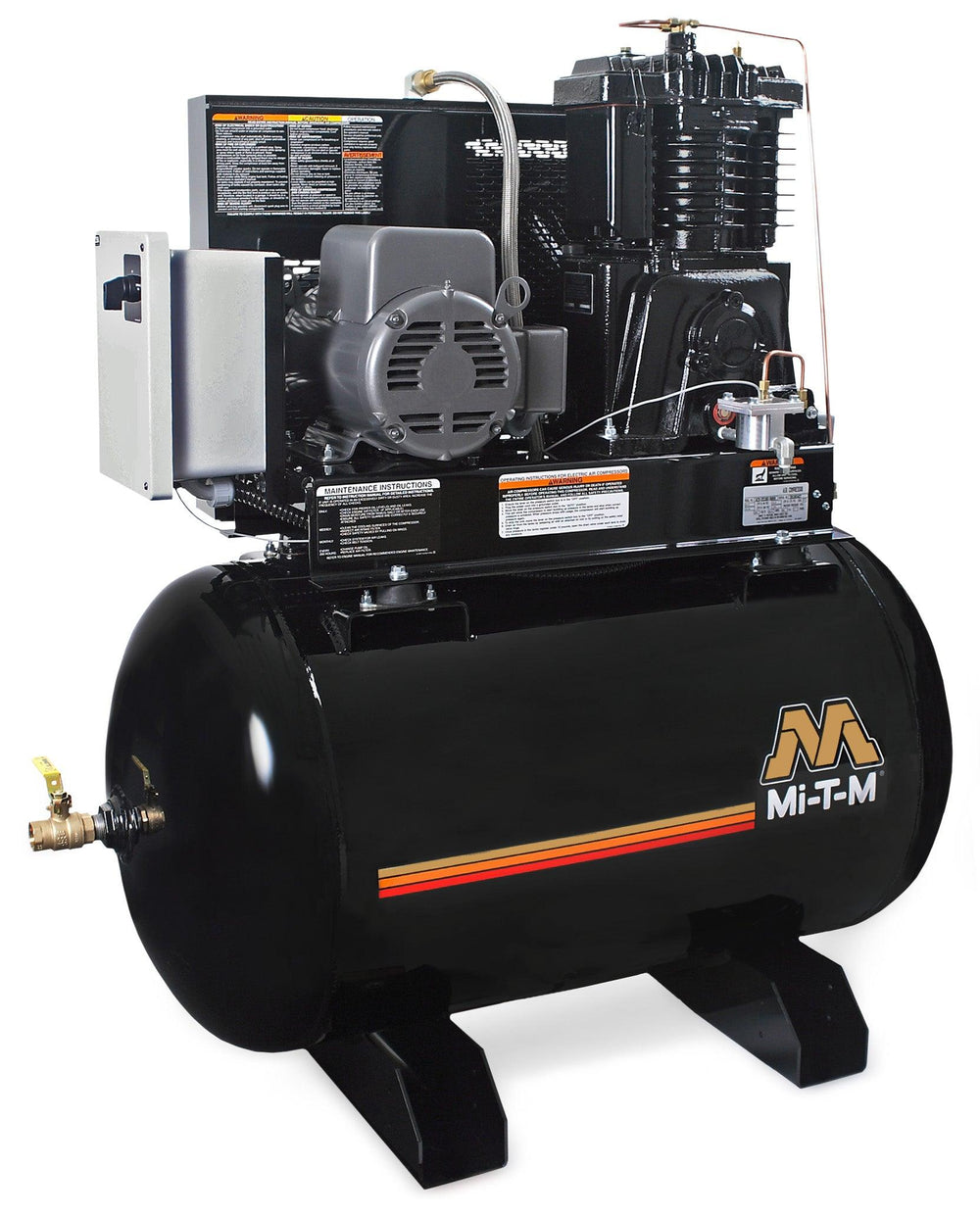
The 8 gallon unit in the table suits a one person garage doing light work. It is not built to feed several techs, so do not size a busy shop off it.
Do you need an 80 gallon tank?
Many sizing guides treat 80 gallons as a common choice for two to three bay shops. The tank stores air so the pump starts less often and pressure stays steadier when several tools pull at once. It does not replace CFM. If your tools use more air than the pump makes, a big tank only delays the pressure drop. For the case for going big, read why an 80 gallon air compressor is the workhorse your auto shop can't live without, or browse our 80 gallon air compressors.
What power does a shop compressor need?
The 80 gallon electric model above is listed as 3 phase. Have an electrician confirm the service, voltage, and breaker at your building before you order. Gas engines make exhaust, so they are not a fit for most enclosed shop spaces. If you are still choosing between one stage and two, see our single stage vs two stage comparison, or our guide on how to choose a 2 stage air compressor.
Not sure whether gas or electric fits your shop? See our gas vs electric two stage air compressor comparison.
Common sizing mistakes
- Counting bays instead of simultaneous users. Five bays does not mean five techs on air at once.
- Skipping the margin. A compressor sized to your exact number has no room for leaks or growth.
- Comparing CFM at different pressures. A rating at 175 PSI is not the same as a rating at 90 PSI.
- Buying on horsepower. Horsepower describes the motor. CFM at a stated PSI describes the air.
- Ordering before checking power. Confirm your electrical service first.
Frequently asked questions
What size air compressor does a 2 bay auto shop need?
Count the techs on air at once, multiply by about 5 CFM, then add 25 to 30 percent. Two techs works out to about 13 CFM. Check your actual tools, since this is a rule of thumb.
How many CFM does an auto shop need?
A common rule of thumb is about 5 CFM per tech using air at the same time, plus a 25 to 30 percent margin. The CFM printed on your tools gives a more exact number.
Is an 80 gallon compressor big enough for an auto shop?
Many sizing guides treat 80 gallons as a common choice for two to three bay shops. Tank size does not replace CFM, so check the pump's CFM at 90 PSI against your number.
What PSI do auto shop air tools need?
Most air tools need 80 to 90 PSI. Check each tool's label, since some need more or less.
Should an auto shop buy a single stage or two stage compressor?
Two stage units suit heavier, longer use with several techs. A single stage unit can work for light, occasional use. Our comparison explains the difference.
Not sure what size your shop needs?
Tell us how many techs run air at once, which tools they use, and what power you have, and we will point you to a model. Call (833) 767-8247 Monday to Friday, 9 AM to 5 PM CST, or contact our team.